
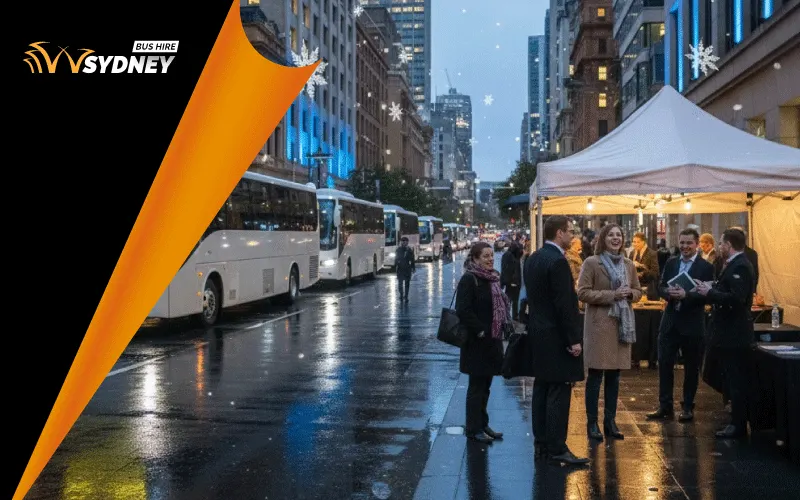
Summary: Staff shuttles provide reliable corporate transport for Sydney CBD winter events by coordinating group arrival, return transfers, and clear pickup communication. A pre-booked shuttle reduces late arrivals, duty-of-care risk, rideshare surges, and admin costs. Corporate teams can scale the same approach nationally using associate transport providers for consistent service standards across Australia.
Corporate-Only Guide to Reliable, Pre-Booked Employee Transport in Sydney
Winter in Sydney is prime time for CBD events.
Between end-of-financial-year functions, conference season, major sporting fixtures, stadium concerts, brand activations, client dinners, and winter cultural calendars, the city’s transport network gets squeezed from every angle: peak-hour congestion, evening road changes, packed trains, rideshare surge pricing, and limited parking near venues.
For corporate teams, that pressure turns into real operational risk:
- late arrivals (and missed agenda items)
- tired staff navigating trains after dark
- inconsistent attendance at optional sessions
- Reputational issues when VIP guests are delayed
- Extra admin chasing receipts and reimbursements
- safety and duty-of-care gaps after late finishes
The fix is simple and scalable: a planned staff shuttle.
This corporate-only guide explains how to design a Sydney CBD staff shuttle solution for the winter events season—so your people arrive together, on time, and return safely, every time.
Why Winter Events Create a “CBD Transport Crunch”
Sydney’s winter calendar compresses a lot of demand into specific windows:
- Weekday early evenings (5:30–7:30 pm) for corporate dinners and launches
- Mid-morning arrivals for conferences and exhibitions
- Late-night departures (9:00–11:30 pm) after events and stadium fixtures
- Weekends with intermittent road changes and major crowd movement
For businesses, the problem is not just traffic. It’s unpredictability.
A train delay, a sudden road closure, or a rideshare shortage can ripple into:
- delayed keynote attendance
- missed client moments
- staff arriving in staggered groups
- poor timekeeping across a multi-session program
A staff shuttle is the “control layer” that brings predictability back.
What a Corporate Staff Shuttle Actually Means
A corporate staff shuttle is a pre-booked, professionally managed transport service that moves your employees (and optionally guests) between:
- offices and the CBD
- hotels and venues
- transport hubs and event precincts
- multiple sites across Sydney (e.g., North Sydney ↔ CBD ↔ Darling Harbour)
Depending on your needs, it can run as:
- One-off event transfers (there and back)
- Shuttle loops (continuous circuits between hotels/offices and venues)
- Multi-day conference shuttles (AM arrival + PM departure + dinner movements)
- Multi-site team logistics (several pickup points feeding one venue)
The key difference versus ad-hoc travel: the whole system is planned, including routes, timings, boarding points, contingencies, and passenger communication.
Why Staff Shuttles Win in Sydney’s CBD During Winter
(1) Predictable arrival times for tight agendas
Winter events season often means stacked schedules: breakfasts, sessions, networking, dinners. Shuttles deliver a consistent arrival window and reduce late arrivals.
(2) A single transport plan that everyone follows
Instead of 40 people improvising routes, you run one plan with a clear meeting point, boarding time, and arrival location.
(3) Better duty of care after dark
Late finishes in winter are common. A return shuttle ensures staff aren’t stranded, fatigued, or forced into unplanned alternatives.
(4) Less admin, fewer reimbursements
A staff shuttle shifts transport from “individual expense chaos” to a single booked service—simplifying finance workflows.
(5) A more professional experience for VIPs
If clients are attending your winter event program, a dedicated vehicle supports punctuality and brand experience.
The Sydney CBD Winter Events Season: What Companies Typically Need
Corporate shuttle demand spikes around:
- conference and exhibition schedules
- EOFY functions and awards nights
- major corporate hospitality evenings
- product launches and press events
- stadium fixtures and premium box hospitality
- multi-office team gatherings and off-sites
The operational pattern is the same: everyone needs to arrive at the same time, and everyone wants a safe exit strategy after the

Common Corporate Shuttle Use Cases
(A) “Office → Venue → Office” event transfers
Best for single-night corporate functions and client entertainment.
Typical structure:
- Office pickup (or central meeting point)
- Direct arrival at the venue drop zone
- Return pickup at the agreed time
Why it works: simple, cost-effective, low admin.
(B) “Hotel → CBD Venue” multi-day conference shuttles
Best for interstate delegations, multi-day programs, and large attendance groups.
Typical structure:
- Morning shuttles in waves
- Midday “top-up” service for late arrivals
- Afternoon departures
- Evening dinner transfers
Why it works: protects the agenda and improves attendance consistency.
(C) “Multi-site pickups → One CBD destination”
Ideal when staff are coming from different hubs: Parramatta, North Sydney, Inner West, Eastern Suburbs. Why it works: reduces late arrivals and stops fragmented travel.
(D) “Stadium hospitality movements”
Great for corporate boxes and client events where the departure surge is intense. Why it works: avoids rideshare surges and ensures clients travel together.
Designing a Staff Shuttle: The Corporate Planner’s Checklist
(1) Set your “non-negotiables”
Decide what matters most:
- punctuality windows (e.g., everyone onsite by 8:30 am)
- safety and return assurance after 10 pm
- brand presentation for VIP guests
- minimal walking distance at drop-off
- accessibility requirements
This determines vehicle type and routing.
(2) Confirm numbers early—then plan for variance
Corporate attendance can fluctuate. The best shuttle plans:
- confirm minimum committed numbers
- allow a small buffer
- Provide an escalation option if numbers increase
(3) Choose pickup points that reduce chaos
Your pickup strategy should be easy to communicate and easy to find.
Good pickup points are:
- consistent
- sheltered when possible
- safe for boarding
- not directly inside heavy traffic choke points
Avoid overly complicated “door-to-door for everyone” unless your numbers are small.
(4) Build time buffers for winter conditions
In winter, you’re more likely to see:
- earlier darkness
- busier evening peaks
- longer dwell times at venues as crowds exit
- weather-related slowdowns
Best practice: add a buffer at both ends, especially for departures after 9 pm.
(5) Plan for the “last 10 minutes” problem
Most event transport fails at the last moment:
- unclear meeting point
- passengers scattered
- venue staff not aligned
- confusion about the return bay
Solve it by:
- One clear return pickup location
- one clear departure time
- one on-the-ground coordinator (or a designated internal lead)
- a single message sent to all passengers (QR/checklist optional)
The Fleet Mix That Works Best for Corporate Shuttles
Your ideal vehicle depends on group size, brand expectations, and route constraints.
Minibuses (small teams + executive movement)
- Great for leadership groups, VIP guests, and smaller offices
- Easier CBD manoeuvrability
- Efficient for short shuttle loops
Mid-size coaches (medium teams + controlled arrival)
- Strong balance of capacity and flexibility
- Ideal for single-site corporate transfers
Full-size coaches (large teams + conferences)
- Best value per seat at higher volumes
- Perfect for hotel ↔ venue shuttles and large corporate attendance groups
A good provider will recommend the most efficient match rather than overselling capacity.
Corporate-Only Benefits You Can Use in Internal Justifications
If you need buy-in from finance, procurement, or HR, frame the shuttle as a business control measure:
- Attendance protection: fewer late arrivals, better session participation
- Risk reduction: a safer return plan, especially after late finishes
- Productivity: less time lost navigating public transport
- Budget control: one managed cost line instead of dozens of reimbursements
- Brand experience: consistent arrival for clients and guests
- Reduced operational load: fewer moving parts for event organisers
National Coverage Without the “National Provider Headache”
Many organisations have teams travelling across multiple Australian cities during the winter events season.
A Sydney-based shuttle plan becomes even more valuable when it can be replicated elsewhere through associate transport providers—meaning your business can maintain consistent planning standards and service expectations beyond Sydney, without trying to source and manage separate suppliers for each city.
This is especially useful for:
- national roadshows
- multi-city conference schedules
- rotating client hospitality nights
- distributed teams attending the same event
Mistakes Corporate Teams Make During the Winter Events Season
Mistake 1: Relying on rideshare for large departures
When thousands leave at once, you don’t control supply or pricing. Shuttles eliminate both variables.
Mistake 2: Underestimating return logistics
Getting to an event is easy. Getting everyone home at 10:45 pm in winter is where plans fail.
Mistake 3: Not communicating clearly
Even the best shuttle fails if the staff don’t know the pickup point. One message, one plan, repeated.
Mistake 4: Booking too late
Winter peak nights (especially Thursday–Saturday) can tighten availability. Early booking preserves options.
Mistake 5: No contingency plan
If your event runs late, the return plan must be adaptable. Build a buffer or agree on a contingency window.
A Practical Shuttle Blueprint for Sydney CBD
Here’s a proven structure for corporate winter events:
Option 1: Single-night corporate event
- 5:45pm pickup (central office point)
- 6:30pm drop near the venue
- 10:15pm return pickup
- 11:00pm return drop
Option 2: Conference day + dinner transfer
- AM arrival waves (7:30, 8:00, 8:30)
- PM departure waves (4:45, 5:15)
- Dinner transfer (6:30)
- Return (9:45 / 10:15)
These patterns keep everything predictable and easy to communicate.
Why The Sydney Coach Company for Corporate Shuttles
For corporate-only operations, you want a provider that understands:
- the value of punctuality windows
- venue constraints and event surge patterns
- professional presentation
- structured communication
- scalable planning (including national reach through associate providers)
The Sydney Coach Company focuses on pre-booked, professionally managed group transport for corporate teams—helping organisers keep control of timing, budgets, and duty of care.
Here’s a proven structure for corporate winter events:
Option 1: Single-night corporate event
- 5:45pm pickup (central office point)
- 6:30pm drop near the venue
- 10:15pm return pickup
- 11:00pm return drop
Option 2: Conference day + dinner transfer
- AM arrival waves (7:30, 8:00, 8:30)
- PM departure waves (4:45, 5:15)
- Dinner transfer (6:30)
- Return (9:45 / 10:15)
These patterns keep everything predictable and easy to communicate.